

Mindful Work: Recognizing & Managing Workplace Stress
Project Summary
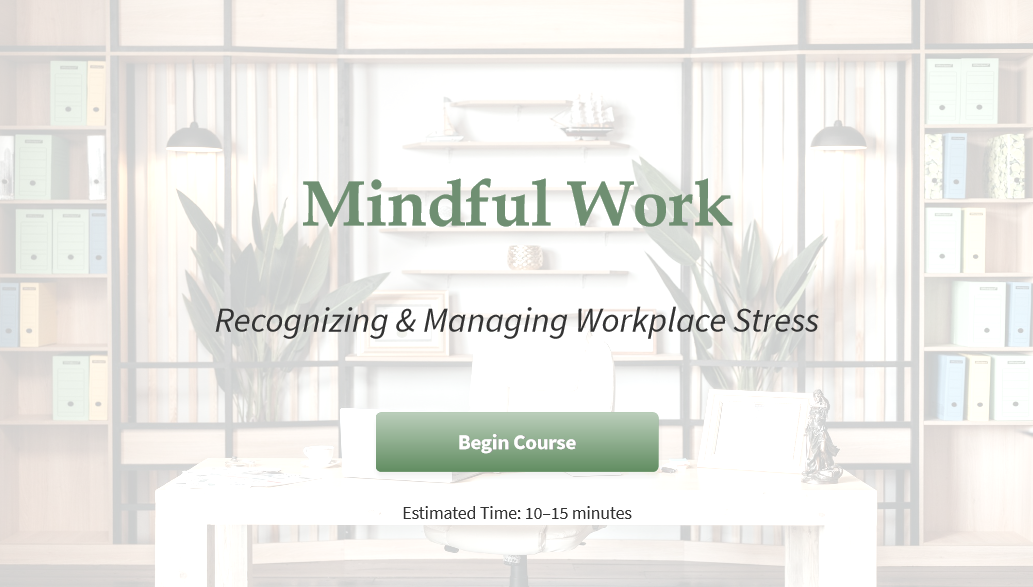
Through realistic scenarios and guided reflection, learners practice recognizing signs of workplace stress, evaluating response options, and applying simple stress-management strategies within the flow of work. The experience emphasizes decision-making under pressure, self-regulation, and psychological safety, supporting both individual well-being and effective workplace behavior.
Project Snapshot
Role: Instructional Designer & Developer
Audience: Workplace employees
Project Type: Scenario-Based eLearning
Delivery: Self-paced
Tool: Articulate Storyline 360
Explore the Learning Experience
Select the preview below to launch the interactive learning experience
Design Reflection
Developing Mindful Work strengthened my ability to design learning around decisions, not information. Building the experience as a realistic workday required me to consider not only what learners needed to know about workplace stress, but when that knowledge would become meaningful and how learners could practice using it. The project also deepened my experience using Storyline interactions, variables, and contextual feedback to create an experience in which learner choices drive the instruction while reflection supports transfer to the workplace.
Design Approach
Scenario-based learning places stress-management concepts within realistic workplace situations
Reflective learning encourages learners to consider their own responses to workplace stress
Decision-based practice gives learners opportunities to choose responses and observe their implications
Progressive challenge introduces competing demands and interruptions throughout the simulated workday
Key Design Decisions
Realistic workday structure provides a coherent context rather than presenting stress-management strategies as isolated information
Branching decisions allow learners to practice responding to workplace stress rather than simply identifying correct strategies
Storyline variables and triggers support learner choices and changes in the experience based on those decisions
Contextual feedback connects learner decisions with potential consequences and alternative approaches
Reflection prompts encourage learners to connect the simulated situations to their own workplace experiences
Minimal content presentation keeps the emphasis on application and decision-making rather than information delivery
Featured Deliverables
Interactive Storyline Module
Scenario-based learning experience built in Articulate Storyline 360Branching Workplace Scenario
Decision points and feedback embedded throughout a simulated workday